How to create BigCommere metafields in bulk
In a practical scenario of setting up a BigCommerce store for the first time, or managing the same, It is often required to create metafields in bulk. We have created the CSV import tool to solve that problem. With our CSV import template you can create 100s of bigcommerce metafields in one click. Creating a CSV file is one of the easiest methods available out there. Even if you are a beginner, you can manage csv files using your favourite spreadsheet tools(like, MS excel, Openoffice Calc etc.) you can download a sample CSV right from the app UI and start preparing the data in the same format.
Understanding the template
| Field Name | Type | Description | Example value |
|---|---|---|---|
| resource_id | number | The BigCommerce id of the resource (For example, product id) | 120 |
| id | number | The BigCommerce id of the metafield | 12 |
| key | string | The key of the metafield | Name |
| value | string | The value of the metafield | Ronaldo Cristiano |
| name | string | The name of the metafield to understand what it is | Employee Name |
| description | string | The description of the metafield to briefly tell what it is | field to store the Employee Name |
| namespace | string | The namespace of the metafield. Example - Multiple employee names can be in the same namespace | Employee |
| permission set | string | The permissions allowed on the metafield | - app_only Private to the app that owns the field - read Visible to other API consumers - write Open for reading and writing by other API consumers - read_and_sf_access Visible to other API consumers, including on storefront - write_and_sf_access Open for reading and writing by other API consumers, including on storefront |
Steps to create Metafields in bulk
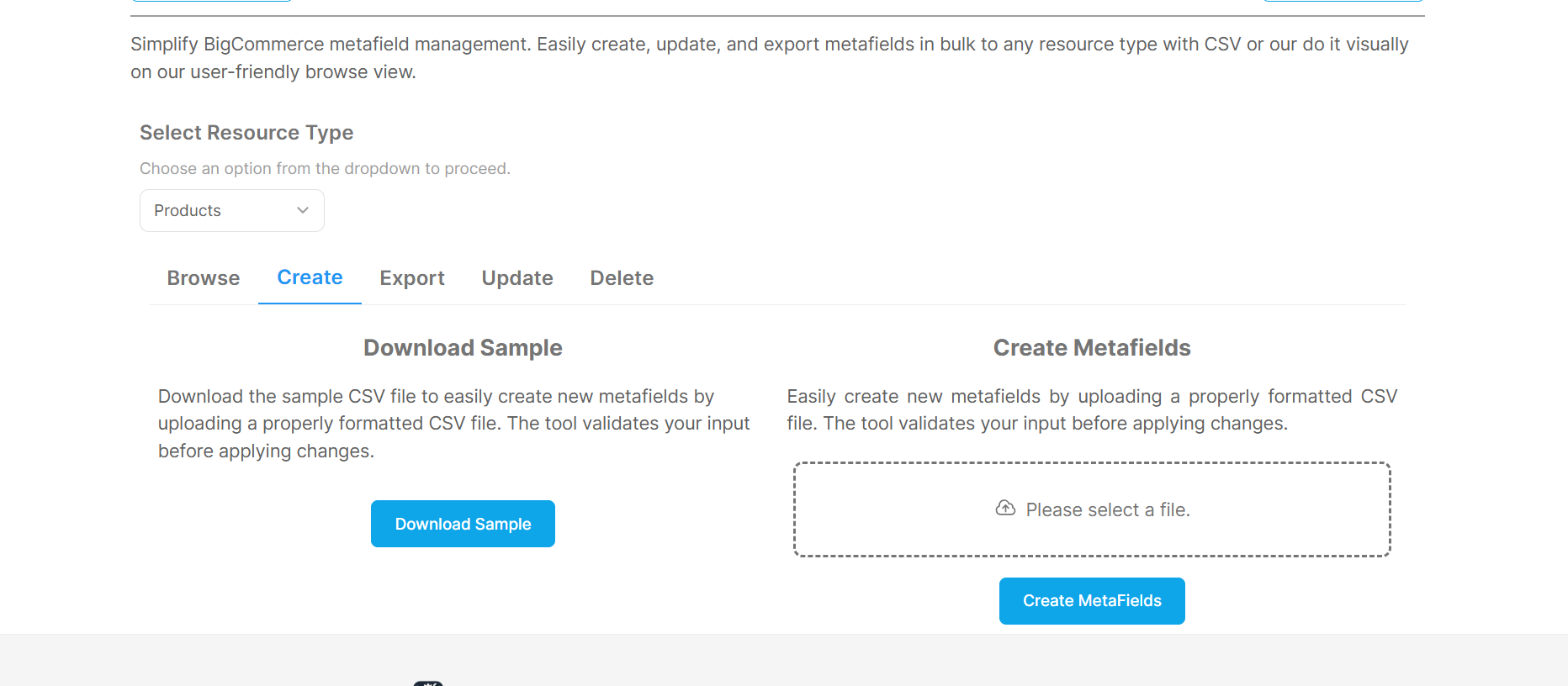
- Step:1 Download the provided template to get started.
- Step:2 Prepare your data in this template, ensuring it adheres to the required format.
- Step:3 Navigate to the app's "create metafields" form and upload your completed template file.
- Step:4 Initiate the creation process by clicking the "create metafields" button.
- Step:5 (Optional) Track the progress of the metafield creation in the app's progress section.
- Step:6 Once you receive the notification that the process is complete, check the status.
- Step:7 (Optional) Manually verify your newly created metafields by exploring them in the "browse" tab.
Here's a glimpse of the user interface.